C05 / A Little Tricky
Three Deliveries Before Sunset
Three collection times survive, along with four short notes. Can the celebration’s delivery list be put back in order?
An original fictional case. All stories and characters are fictional.
The Story
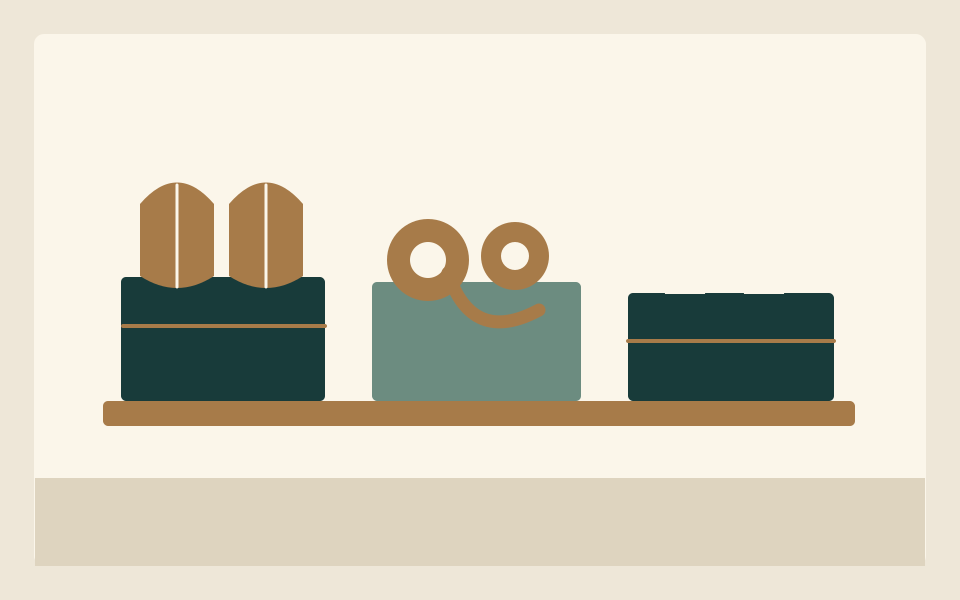
The celebration was meant to begin at sunset, but its preparations were scattered across a bright afternoon. Asha was hanging photographs, Ben was arranging the garden tables, and Cleo was helping put up a small welcome sign. Each had agreed to collect one delivery from the hall’s side desk. The three deliveries were paper lanterns, rolls of ribbon, and paper cups. Nothing in the parcels was fragile, secret, or especially valuable; the problem was simply knowing which person had taken which box.
There were exactly three collections, all on the same afternoon and all recorded by the event desk’s single clock: 15:10, 15:30, and 15:50. Each person collected once, at a different listed time, and each of the three items was collected once. No one collected on another person’s behalf. The boxes then went to different preparation areas, where their delivery labels were removed for reuse. Later, a spilled drink blurred the main list’s connecting lines between names, items, and times.
The desk volunteer, Mira, still had four separate notes. They were accurate, and together they contained all the restrictions needed to restore the list. Asha’s note said, “My collection was not the first of the three.” Cleo’s note said, “I collected after Asha.” Ben’s receipt named the paper lanterns. A small desk slip recorded that the ribbons were collected at 15:30. The notes did not contain hidden meanings or approximate times.
Mira wrote the four statements on a clean sheet without adding anything from memory. She could remember the party’s menu and the color of the tablecloths, but neither belonged in the matching problem. She also resisted a guess based on the jobs people were doing. Hanging photographs did not automatically mean collecting ribbon, and arranging tables did not automatically mean collecting cups. People had volunteered for whatever collection fitted their route.
The clean sheet therefore had three short lists: Asha, Ben, Cleo; lanterns, ribbons, cups; 15:10, 15:30, 15:50. Underneath sat the four statements. Mira drew no extra column for a car, a room, a favorite color, or a person’s age. They would need to match the three groups, but not invent a fourth category to make the task look more complicated.
When Asha passed the desk for scissors, Mira asked only whether her written note was still correct. Asha confirmed that it was. She did not add another clue. Ben later brought back an empty box, but its appearance was not recorded as evidence, and Cleo was too busy with the welcome sign to join the discussion. The puzzle remained exactly the little collection problem shown on the sheet.
One volunteer suggested starting with Ben’s item, because it was the most direct statement. Another suggested starting with the order between Asha and Cleo. Either could be a reasonable place to begin. Mira wanted a full arrangement that satisfied every statement at once, rather than three separate guesses that each sounded plausible. A person could fit a time locally and still make the remaining two impossible.
As the garden filled with the sounds of chairs being unfolded, the damaged list became a surprisingly pleasant pause. Nobody was suspected of taking an extra parcel. The deliveries had all reached the celebration. Restoring their connections would simply let Mira finish the handover record and return the reusable labels to a box. The clean sheet waited for three complete rows, with no gaps left to fill from a hunch.
Written records
The four surviving records
| Record | Exact information |
|---|---|
| Asha’s note | Asha did not collect first. |
| Cleo’s note | Cleo collected after Asha. |
| Ben’s receipt | Ben collected the lanterns. |
| Desk slip | The ribbons were collected at 15:30. |
The Clues
- Each person, item, and listed time is used exactly once; no collection was made on someone else’s behalf.
- Asha was not first, and Cleo collected after Asha.
- Ben collected the lanterns.
- The ribbons were collected at 15:30.
Your Question
Match each person to one item and one collection time. Is there exactly one arrangement consistent with all four records?
Take a moment with the facts, or use a hint below. You can open the explanation at any time.
Hint 1
Consider which time Asha could have if she was not first but somebody still collected after her.
Hint 2
Once Asha’s time is fixed, Cleo’s follows. Use Ben’s named item and the ribbon timestamp to finish the three rows.
Reveal the Truth — spoilers ahead
The explanation
Asha must have collected at 15:30. She was not first, so she cannot be at 15:10. She cannot be at 15:50 either, because Cleo collected after her and no later collection exists. That leaves the middle time. Cleo must then be at 15:50, leaving 15:10 for Ben. These assignments use the order statements together, rather than treating either as a complete answer on its own.
The ribbons were collected at 15:30, so they were Asha’s item. Ben’s receipt names the lanterns, placing those at 15:10. The only remaining item is the cups, which therefore belong with Cleo at 15:50. The complete arrangement is Ben — lanterns — 15:10; Asha — ribbons — 15:30; Cleo — cups — 15:50.
No second arrangement can change Asha’s time without breaking one of the two order statements. Once the people’s times are fixed, the ribbon timestamp and Ben’s receipt fix two items, leaving only one place for the third.
Mira rewrote the list and asked the three collectors to check their rows when they had a moment. Ben hung the final lantern while Cleo put the cups beside the water jug. Asha tied a ribbon around the spare-label box, making it much easier to find than the afternoon’s original paperwork. The record was complete before the first guest arrived.